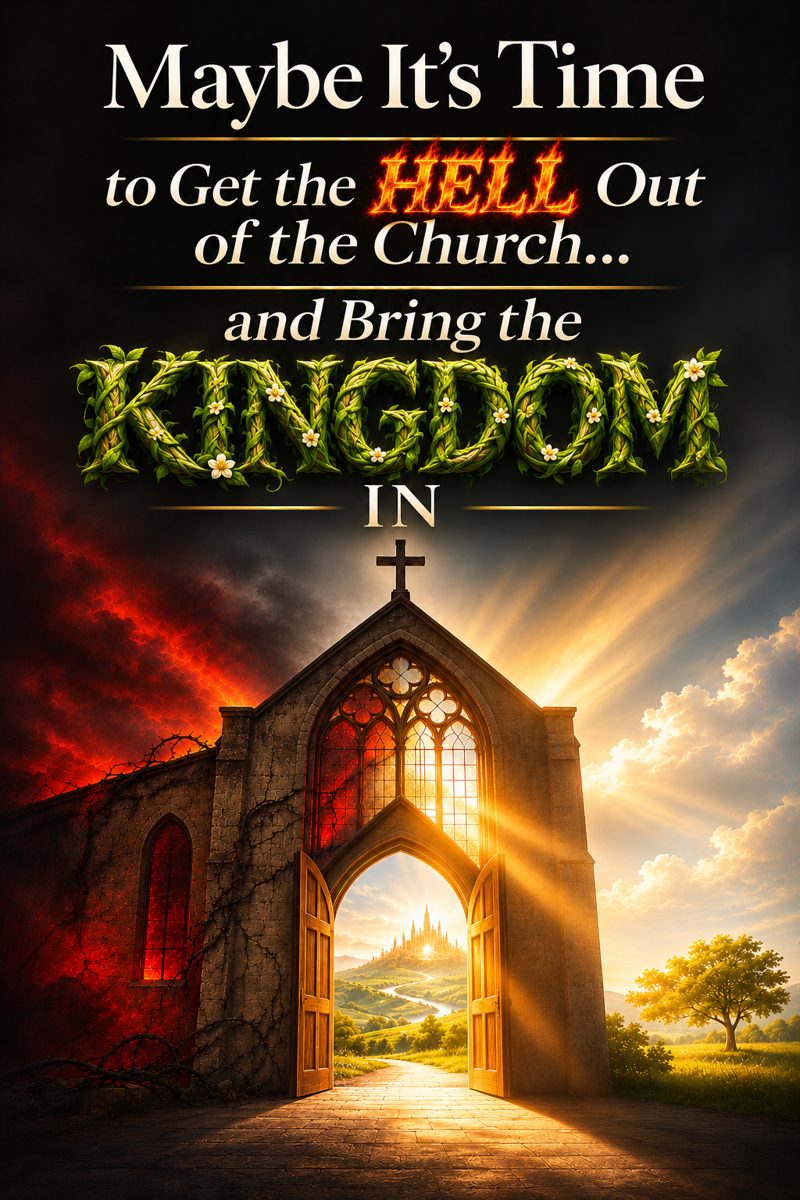
Why I wrote it
Most of us know whose side we're on when we read the Bible. We're with Moses, not Pharaoh. We're with Jesus, somewhere in the crowd, leaning in. We certainly wouldn't have been the religious people trying to shut him up.
But they didn't think they were the villains either. Many of them cared deeply about God, and were certain they already knew what God would look like. That's the question this book started with, and it wouldn't leave me alone: what if we've been reading the story wrong? What if, in some of the ways that matter most, we are the ones guarding the door?
For me, the place it led was hell. Not the reality of evil, and not the seriousness of our choices, but the belief that God will leave people in conscious suffering forever. I came to see that this belief isn't a small detail at the edge of the faith. It quietly organizes almost everything else. It turns the person beside us into an emergency. It makes an honest question feel dangerous. And it puts fear at the center of a message we say is about love.
A question is not genuinely a question if only one answer is safe.
So the title means two things. The first half of the book is about getting the hell out of the church: letting go of a fear that was never part of the good news. The second half is about what takes its place. When fear stops organizing our faith, love, generosity and the kind of justice Jesus practiced can. That's the Kingdom, and it isn't somewhere we go after we die. It starts here, among us, and it moves outward.
A love letter, not a hate letter
I know how the title sounds. I chose it anyway, because I think it's true. But this is not a book against the church. It's a book for it.
The church is full of people who give generously, care for the sick, welcome strangers, and carry burdens no one else sees. Any account of Christianity that leaves those people out isn't honest, and I'm not interested in pretending they don't exist. I'm not asking anyone to leave their congregation, or the friendship, worship and shared life that can make a church beautiful.
I love the church. Everything in this book comes from wanting it to become more fully what it's called to be: a place where people meet a God who is love, and where that love doesn't stay inside the building.
I'm not a Bible scholar, and this isn't a fight over proof texts. It's a long look at the whole story, the character of God as Jesus shows him to us, and the fruit our beliefs are bearing. I don't expect you to agree with all of it. I hope you'll question what I've written as freely as I've questioned what I was taught. The truth has nothing to fear from our questions.
Help me write it
This book isn't finished, and I don't want to finish it alone. The draft lives in an open Google Doc that anyone can read and comment on. Every comment and suggestion comes straight to me.
The hardest part has been knowing what to cut. The book is long, and I want to pull out whatever isn't pulling its weight without losing its heart. You don't have to read the whole thing to help. One chapter is a gift.
- Open the draft and use the outline (the small list icon at the top left) to jump to any chapter.
- Leave a comment by highlighting a passage and clicking the comment button. Tell me where something is confusing, unconvincing, repetitive, moving, or missing.
- Say "keep" or "cut," and tell me why. Both are just as useful.
- Suggest small fixes directly. Switch to Suggesting mode (the pencil icon at the top right), and your changes show up in color for me to accept or decline.
- Be kind to other readers. Reply to their comments if you'd like, but please don't resolve or delete them.
And if you know someone who would want to read it, or who would push back on it, please send it to them. I'm looking for as many honest voices as I can find.
Read it your way
- The living draftNewest Google Doc. Always the latest version, and the place to leave comments and suggestions.
- PDF For printing, or reading on a tablet or computer.
- EPUB For Apple Books, Kindle (through Send to Kindle), Kobo and most e-readers.
The PDF and EPUB are snapshots from November 2026. The draft keeps changing as readers weigh in, so the Google Doc is always the most current.
Free to share
I've given up all rights to this book. You're free to copy it, share it, print it, translate it, adapt it, teach from it and build on it, for any purpose, without asking me first.
The reason is simple. These ideas came to me freely. I didn't earn them, and they were never really mine to hold onto. I want them to go out into the world the same way they came to me.
The book is dedicated to the public domain under the CC0 1.0 Universal Public Domain Dedication. To the extent possible under law, Corey Brown has waived all copyright and related rights to this work.
The Original Red Pill
This book is written to the church. But the ideas in it were never meant only for people who already sit in a pew. So alongside the book, I'm building something for everyone else.
It's called The Original Red Pill. It takes the ideas from this book, adds a few more, and builds them for the secular world. There are no church words at the start. It begins with the lives most of us are actually living: what we chase, what we're afraid of, and what we've mistaken for the real thing. The faith is there the whole time, underneath everything, like soil under a garden. It just isn't the first thing you see.
That's on purpose. Too many people have only ever experienced religion as a way of drawing lines: who's in and who's out, who's right and who's better. If they heard the words first, they'd stop listening before they ever got to the good part. So the Red Pill shows the good part first. Only after a reader has seen it for themselves does it turn around and say: this story is not new. The things you just recognized as true are what Jesus and the prophets were teaching all along.
What religion is teaching, at its best, was never a way to separate from everyone and be better than them. It's a path to authenticity, joy and connection with everyone. It's about smashing barriers, not building them.
Like the book, it's being built in the open, and I'd love your help. The heart of it is the Lab, a set of short pieces you can read one at a time. Every piece has room for comments, a quick rating for clarity and length, and a simple vote: did this add to the argument? We're collecting all of it to see what works, what doesn't, and what's missing. Read a piece or two, tell us where it lands and where it falls flat, and share it with someone who would never pick up a book like this one.